How to Choose the Right UX Design Agency in the UK

The UX Agency Selection Problem
Choosing a UX design agency in the UK is harder than it should be. The market is crowded, the quality varies enormously, and agencies are (unsurprisingly) very good at presenting themselves well. A polished website and a strong case study portfolio are table stakes — they don't reliably predict whether an agency will be right for your specific project. Some of the market also markets itself as a "user experience agency" rather than a UX design agency — see our user experience agency vs UX design agency guide if the naming difference is throwing you off during shortlisting.
This guide is designed to help you cut through the presentation layer and make a selection decision you can feel confident about — one based on genuine capability, cultural fit, and the specific requirements of your project. If your product is fintech or another high-stakes B2B SaaS category, see our UX design agency for fintech & SaaS guide for the extra checks that category requires.
Step 1: Get Clear on What You Actually Need
Before you approach any agency, you need a clear picture of what you're trying to achieve and what kind of help you need to get there. Agencies will default to scoping what they're good at if you don't come with a clear requirement.
Define the problem, not the solution
Don't approach an agency with "we need a redesign." Approach them with "our checkout abandonment rate is 78% and we don't know why" or "users are signing up for our free trial but only 4% convert to paid and we can't figure out what's blocking them." The more specifically you can describe the problem, the more accurately agencies can scope a solution — and the more clearly you can evaluate whether their proposed approach makes sense.
Know your budget range
Not having a budget in mind when approaching agencies leads to wasted time on both sides. You don't need an exact number, but knowing whether you're working with £5,000, £20,000, or £100,000 shapes everything about what approach is realistic. Agencies that don't ask about budget early should make you mildly nervous — it suggests they're not thinking practically about scope.
Understand your timeline and constraints
Do you have a fundraise in three months that means you need a working product by then? A product launch already scheduled? An upcoming contract renewal that depends on a feature being ready? These constraints shape what's possible and which agencies can realistically accommodate your needs.
Step 2: Evaluate the Portfolio Properly
Most agency websites show beautiful case studies. Here's how to look at them more critically.
Look for outcomes, not outputs
A case study that shows beautiful screens is evidence of design skill. A case study that shows "we redesigned the onboarding flow and conversion increased from 3% to 11%" is evidence of impact. When evaluating portfolios, ask: does this agency talk about what their work achieved, or just what it looked like? Agencies who track outcomes are agencies who understand that design is a means to an end, not an end in itself.
Look for industries and problem types similar to yours
An agency that has designed three B2B SaaS platforms has pattern recognition about the problems that arise in that context that's genuinely valuable. An agency that has only designed consumer apps might do perfectly good work on your B2B product, but they're building that knowledge from scratch on your budget. Relevant experience reduces risk.
Read the case studies end to end
How did they define the problem? What research did they do? What decisions did they make and why? What would they do differently? The quality of thinking visible in a case study tells you far more than the quality of the final screenshots.
Ask about projects that didn't go as planned
Every agency has had projects that hit problems — scope changes, client feedback that redirected the design, technical constraints that required redesign, research findings that upended early assumptions. How agencies handle these moments tells you about their maturity. Be cautious of any agency that claims every project ran perfectly.
Step 3: Assess Research Capability
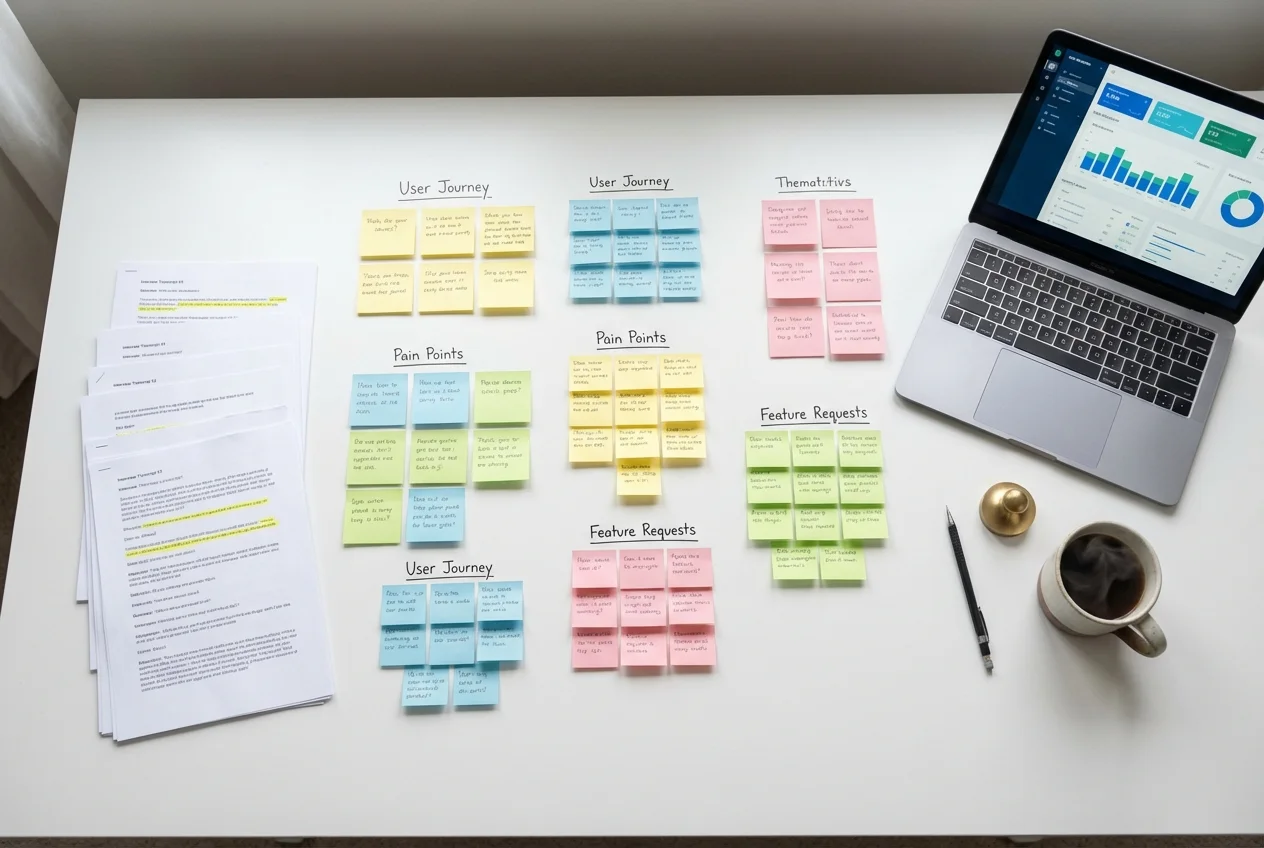
This is the most important and most commonly overlooked evaluation criterion. UX design without user research is guesswork. Before you commit to an agency, understand exactly how they approach research.
Ask specifically: "What research would you do on this project and why?"
A strong UX agency will give you a specific, thoughtful answer: "Given that you have an existing product with real users, we'd start by running moderated usability sessions with six to eight target users, combined with a review of your analytics and a heuristic audit. We'd expect the research to take two to three weeks and produce a synthesis report that would inform the wireframing phase." That's a specific, grounded answer. "We do user research as part of our process" is not.
Ask to see a research synthesis report from a previous project
Many agencies will have portfolio case studies but fewer will have examples of their research outputs. Asking to see a redacted research report (with client information removed) tells you a lot about the quality and rigour of their research practice.
Ask who does the research
Is there a dedicated UX researcher on staff, or does the same person do research, wireframing, and visual design? There's nothing wrong with generalist designers who do research — many do it well — but the quality of research tends to be higher when it's a core speciality rather than one of many hats a designer wears.
Step 4: Understand Who Will Work on Your Project
The bait-and-switch is unfortunately common in agency world: senior, experienced team members lead the pitch, and more junior team members do the actual work. It's not always malicious — agencies need to develop junior talent — but you need to understand what you're signing up for.
Ask directly: who will be the lead designer on this project? What is their experience level? Can I meet them before we start? Will they be involved throughout, or do they hand off to others at certain stages? These are fair questions, and a good agency will answer them without defensiveness.
At smaller boutique agencies, you're more likely to be working directly with senior people throughout. At larger agencies, you may be working with a mixed team — which isn't necessarily worse, but you should understand the seniority and experience of the people involved.
Step 5: Evaluate Communication Style and Process Transparency
Design projects require close collaboration between agency and client. The working relationship matters as much as the design capability.
How do they handle feedback?
Ask them to describe how they incorporate client feedback into the design process. Good agencies have a structured feedback process — defined review points, specific questions to guide feedback, and a clear mechanism for handling disagreements. "We just iterate until the client is happy" is a red flag — it suggests no structured quality process and potential for endless, directionless revision cycles.
How do they handle scope changes?
Scope changes happen on almost every project. How an agency manages them determines whether those changes create conflict or are handled professionally. Ask for their change control process. They should have one.
How frequently will you communicate?
What cadence of meetings, check-ins, and project updates can you expect? Will you have a dedicated project manager or is the designer managing the relationship? How quickly do they typically respond to emails or messages? These practical questions matter a lot when you're mid-project.
Step 6: Check References Properly
References are only useful if you ask the right questions. Don't ask "did you like working with them?" — the answer is almost always yes, or they wouldn't have agreed to be a reference. Instead ask:
- What were the biggest challenges on the project and how did the agency handle them?
- Did the project come in on time and budget? If not, why not?
- Were there any moments where you disagreed with the agency's direction? How did they handle that?
- What would you do differently knowing what you know now?
- Would you work with them again — and have you?
Repeat clients are the strongest possible endorsement. If an agency has worked with the same client on multiple projects, it says something meaningful about the quality of the relationship and the consistency of the work.
Step 7: Evaluate the Proposal Carefully
The proposal is where you see how an agency thinks about your project. A good proposal should clearly explain the problem as they understood it, the proposed approach and why it's appropriate for this project, specific deliverables at each stage, a realistic timeline with milestones, clear pricing with an explanation of what drives cost, and what they need from you to make the project successful.
A proposal that's a cut-and-paste of their standard service offering, with your company name swapped in, suggests they haven't thought hard about your specific situation. A proposal that reflects a genuine understanding of your problem and proposes a specific, reasoned approach suggests they have.
Red Flags to Watch For
- They agree with everything you say. Good agencies push back. They challenge briefs, question assumptions, and tell you when an idea isn't user-validated. Agencies that only say yes are optimising for winning the brief, not for delivering good work.
- Vague research process. "We do extensive user research" without specifics is a yellow flag. Press for details.
- No mention of testing. Usability testing is a standard part of rigorous UX practice. If it's not in the scope, ask why.
- Very low prices without clear explanation of trade-offs. Cheap UX usually means junior resource, abbreviated research, or both. It's not always bad, but understand what you're getting.
- Excessive jargon. Agencies that explain their process in impenetrable buzzwords are often obscuring the fact that their process isn't that sophisticated. Good UX thinking should be explainable in plain English.
If you're weighing up a full-service digital agency against a specialist, our UX design agency homepage lays out how we structure evidence-led engagements for UK B2B teams.
Making the Final Decision
After a proper evaluation process, you typically end up with one or two agencies who look genuinely right for the project. At that point, the deciding factor is often gut feel — and that's legitimate. You're going to be working closely with these people for weeks or months. If a team you've met seems smart, honest, genuinely interested in your problem, and easy to communicate with, that's meaningful data. If something feels off, it's worth listening to that instinct even if you can't articulate exactly why.
The best client-agency relationships are partnerships. Agencies that approach projects as a transaction, and clients who treat agencies like vendors, produce worse outcomes than partnerships where both sides are genuinely invested in the result. Look for an agency that seems as interested in your success as you are — and be the client who makes it easy for them to do their best work.
 UX Research
 UX Audit
 UX Strategy