UX Research Agency UK | B2B User Research That Drives Product Decisions

What Is a UX Research Agency and When Do You Need One?
A UX research agency is a specialist firm that conducts systematic user research on behalf of product teams — interviews, usability tests, diary studies, surveys, and analytics reviews — and translates findings into evidence-based design and product decisions. For UK B2B organisations, the decision to engage a UX research agency typically comes at one of four moments: before a major redesign, when internal assumptions about user needs have diverged from observed behaviour; during a product plateau, when a well-built product fails to convert or retain users as expected; when entering a new market segment with different professional user profiles; or when commissioning a design sprint that needs research validation before committing to a direction.
The value of an external user research agency UK over in-house research is not primarily cost — it is perspective. Internal teams accumulate institutional blindspots. Researchers who have worked on the same product for two years start to see what the product team believes rather than what users actually experience. An external research agency brings fresh eyes, professional recruitment, and cross-industry benchmarking that an in-house team cannot replicate. The counter-argument — that external researchers lack domain knowledge — is true for the first engagement and less true for every subsequent one.
UX Research Methodologies for B2B Products
B2B product research differs from consumer research in three structural ways. First, participants are harder to recruit: you need professionals who match specific job functions, seniority levels, and product contexts, not just demographic segments. Second, the research questions are often about complex multi-step workflows rather than simple preference tasks. Third, the commercial stakes per participant are higher — a senior product director spending an hour in a research session is a significant time investment that must be respected and rewarded. UK UX research agencies that understand B2B work design their methodology accordingly.
The most productive B2B UX research methodologies, in rough order of evidentiary strength for product decisions, are: moderated usability testing (watching real users attempt real tasks with a skilled facilitator who probes when things go wrong); contextual inquiry (observational research conducted in the user's actual work environment, revealing workarounds and context that a lab study never surfaces); stakeholder and user interviews (structured conversation to understand mental models, job-to-be-done, and the gap between desired and actual workflows); unmoderated remote testing (scalable, faster, and useful for funnel-specific questions when you have precise hypotheses); and survey research (valuable for quantifying findings from qualitative studies, not for generating insight independently).
For most B2B product teams, the most high-ROI starting point is moderated usability testing on the three to five core workflows that drive activation and retention. Five sessions with representative users typically surfaces 80% of critical issues — a principle that holds across twenty years of usability research. Our UX research service structures every engagement around this principle: fewer, better-selected participants with richer session design, rather than large sample sizes with shallow protocol.
What Good UX Research Output Looks Like for UK B2B Teams
The output of a UX research engagement is only as useful as its format. Too many research reports are long, beautifully formatted PDFs that generate one stakeholder meeting and then sit unread in a shared drive. A UX research agency UK that serves B2B product teams designs its outputs for sprint integration, not for executive theatre.
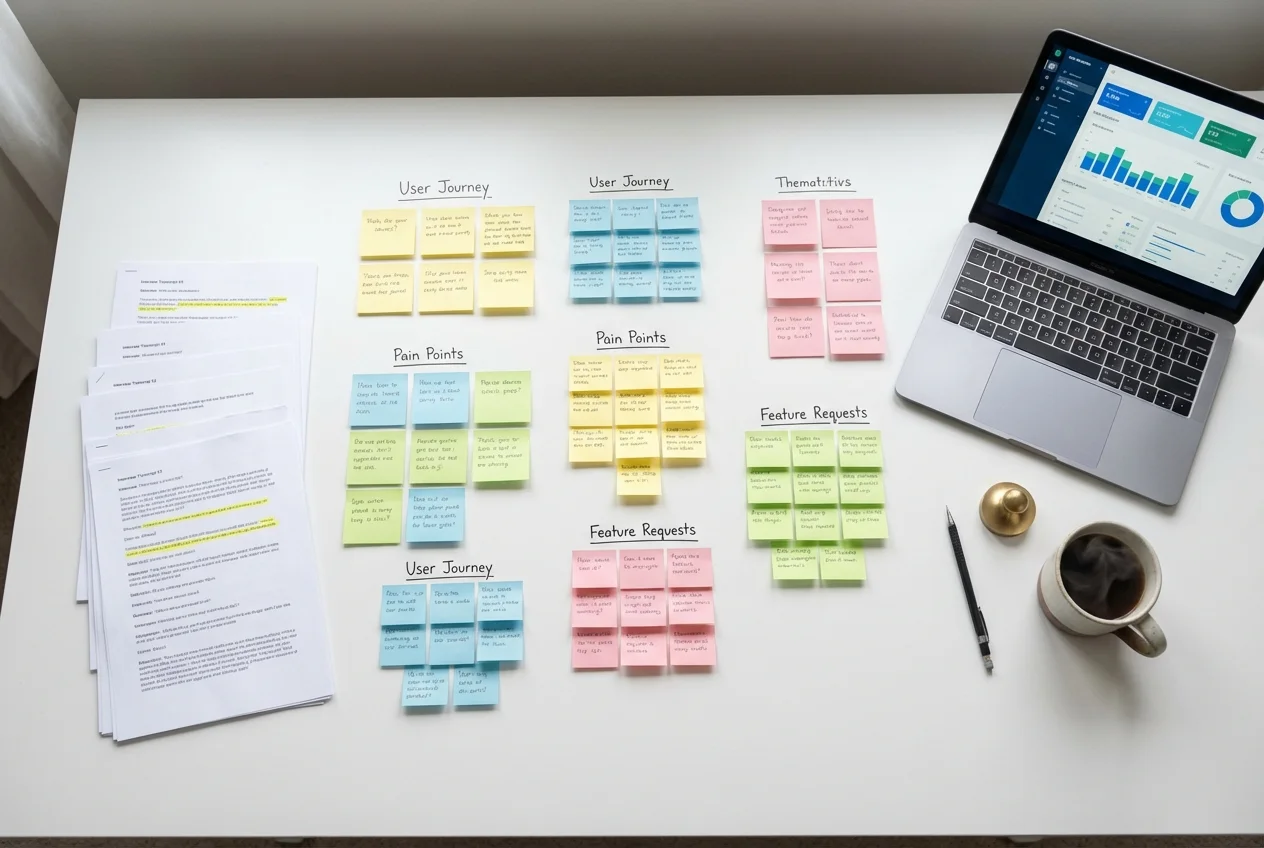
Effective research deliverables for B2B product teams include: a synthesis document that leads with the three to five highest-severity findings, each accompanied by two to three supporting video clips, a root-cause analysis, and a specific design recommendation; a prioritised issue backlog formatted for direct import into Jira, Linear, or your preferred sprint tool, with severity, effort, and business impact ratings; a set of validated user journeys annotated with friction points and mental model mismatches; and — critically — a research implications brief that connects findings to product strategy, not just to screen fixes.
The implications brief is what separates research that changes product direction from research that generates a backlog. If your usability sessions reveal that users misunderstand the fundamental value proposition of your product by step three of onboarding, fixing the onboarding UI is a symptom treatment. The implications brief would surface the upstream question: is the positioning misaligned, is the onboarding narrative sequence wrong, or is the product itself missing a prerequisite capability that users expect? These are strategy questions that a good UX research agency raises — and connects to your broader UX strategy work through the UX strategy service.
Recruiting B2B Research Participants: The Hard Part No One Talks About
The most common failure mode in B2B UX research is participant recruitment. Recruiting five senior procurement managers at FTSE 250 companies who actually use your product category is not the same as recruiting five adults who shop online. The difference is significant: poor recruitment produces research findings that are accurate for the wrong population — a finding that your product is confusing to junior users when it is designed for senior practitioners is useless at best and actively misleading at worst.
A specialist UK UX research agency for B2B products has established participant recruitment infrastructure: professional panels screened for job function, seniority, and industry vertical; incentive structures appropriate for senior business professionals (cash or charity donation, not gift vouchers); and screener design that ensures the recruited participants genuinely match your user profile, not just the demographic surface. Before commissioning any research agency, ask to see a screener from a comparable B2B engagement and the recruitment methodology they use. An agency that relies on consumer panels for B2B professional recruitment will deliver flawed research regardless of how skilled the facilitators are.
Our recruitment process for B2B user research uses a combination of proprietary professional panels, LinkedIn-sourced outreach for niche verticals, and — where possible — client-supplied participant lists (customer and non-customer) to ensure genuine representativeness. For fintech, enterprise SaaS, and professional services platforms, this nuanced approach to recruitment makes the difference between research that confirms assumptions and research that challenges them. Read how we applied this in practice in our usability testing agency UK guide.
UX Research Agency UK: Integrating Findings Into Your Product Roadmap
Research findings that do not influence the roadmap are a cost, not an investment. The gap between research insight and roadmap decision is where most UX research programmes fail. A research report lands; the product team is convinced by the findings; and then sprint priorities, engineering capacity, and stakeholder competing agendas absorb the next four sprints before any finding is acted on. By the time capacity frees up, the context has shifted and the findings are stale.
The most effective way to prevent this is to treat research integration as a design problem in its own right. Concretely: schedule a roadmap integration workshop within one week of research sign-off, when findings are fresh and the research team is still available to answer questions; produce a "top five fixes" executive summary formatted for the leadership meeting where roadmap is decided; and assign a named product owner for each top-priority finding so accountability is clear. The user research agency UK teams who consistently generate roadmap impact do this work — they do not stop at the research report.
At our agency, every research engagement includes a two-hour roadmap integration workshop as standard. We come to the workshop with a prioritised recommendation stack, a set of "if you could only do three things" hypotheticals for constrained sprint capacity, and design concept sketches for the top three critical issues so the team can see what "fixed" looks like before committing to the sprint work. This dramatically reduces the time from research to shipped fix. For more on how research connects to conversion improvement, our interaction design and B2B conversion guide covers the commercial evidence.
How to Choose the Right UX Research Agency for Your UK B2B Product
Evaluating UK UX research agencies is harder than evaluating web design agencies because the quality of research is less visible than the quality of visual design. You cannot look at a research portfolio the way you can look at a design portfolio. The evaluation criteria that actually matter are: the agency's B2B sector experience (have they researched products used by similar professional users?); their recruitment methodology (can they reliably reach your target professional user profile?); their facilitation approach (do their researchers know how to probe without leading?); and their output quality (do their reports drive roadmap decisions, or do they sit on shelves?).
The most reliable signal is case study specificity. Ask any prospective UX research agency UK for a case study that describes: the research question, the methodology used, three specific findings from the research, and a concrete product change that resulted from those findings. An agency that answers this concretely — with specific interaction failures, specific design changes, and specific before/after conversion data — has the culture and process to produce research that drives decisions. An agency that answers with general descriptions of "insights" and "collaborative workshops" does not.
For a broader framework for evaluating UK design agencies, our how to choose a UI UX design agency UK guide covers the full evaluation methodology. For a shortlist of what makes a research-led design engagement different from a generalist digital engagement, our best UX design agency UK buyers guide sets the benchmark. Ready to scope a research engagement? Book a free 30-minute research consultation and we will tell you which methodology fits your question, what recruitment looks like for your user profile, and what a realistic investment and timeline looks like for your product.
B2B User Research: Quick Answers
What makes B2B user research different from consumer research?
B2B user research has to account for multiple stakeholders per account — buyer, admin, day-to-day user — rather than one consumer decision-maker. Recruitment is harder (professional participants, not consumer panels), sessions run longer, and findings need to map to business metrics like adoption and renewal rather than pure usability.
How many participants do you need for reliable B2B user research?
Five moderated sessions per user segment typically surface 80%+ of critical usability issues. For B2B products with two or three distinct user roles, that means 10–15 sessions total gives you a robust evidence base without over-researching.
How much does a B2B user research engagement cost in the UK?
A focused B2B user research study — five to eight participant interviews plus a findings report — typically runs £5,000–£20,000 depending on recruitment difficulty and reporting depth. Our UX agency pricing guide breaks this down further.
Can B2B user research run alongside an active sprint cycle?
Yes — most of our B2B user research engagements run in parallel with live product sprints, feeding findings into planning every one to two weeks rather than delivering a single report at the end.
Do you offer B2B user research as a standalone engagement, or only bundled with design?
Both. Many clients start with a standalone UX research engagement to validate direction before committing to a full design programme; others run research and design together for speed.
 UX Research
 UX Audit
 UX Strategy